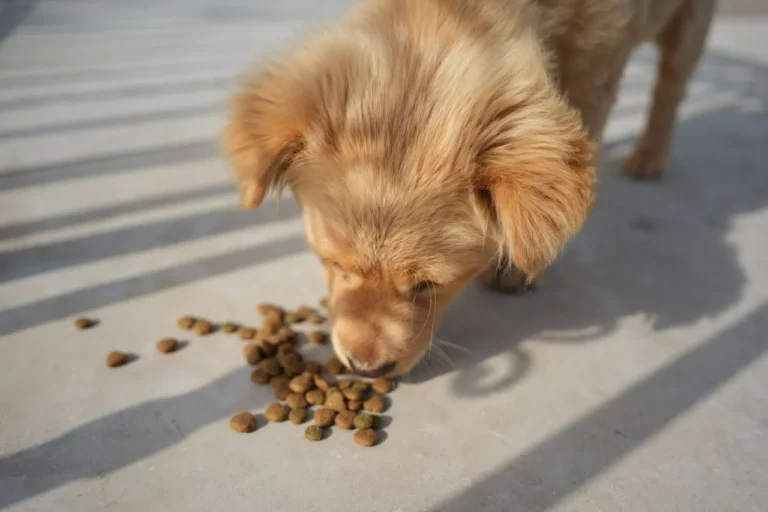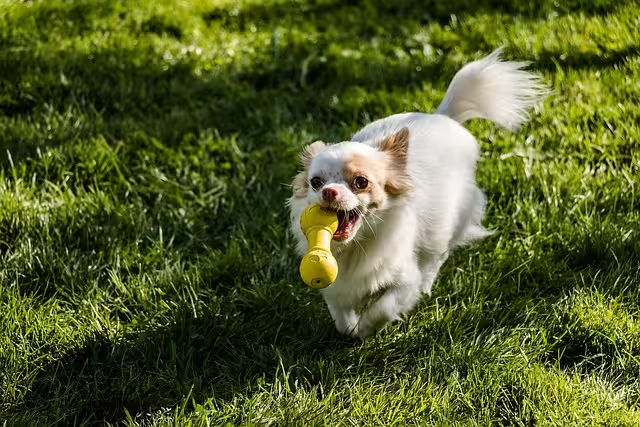
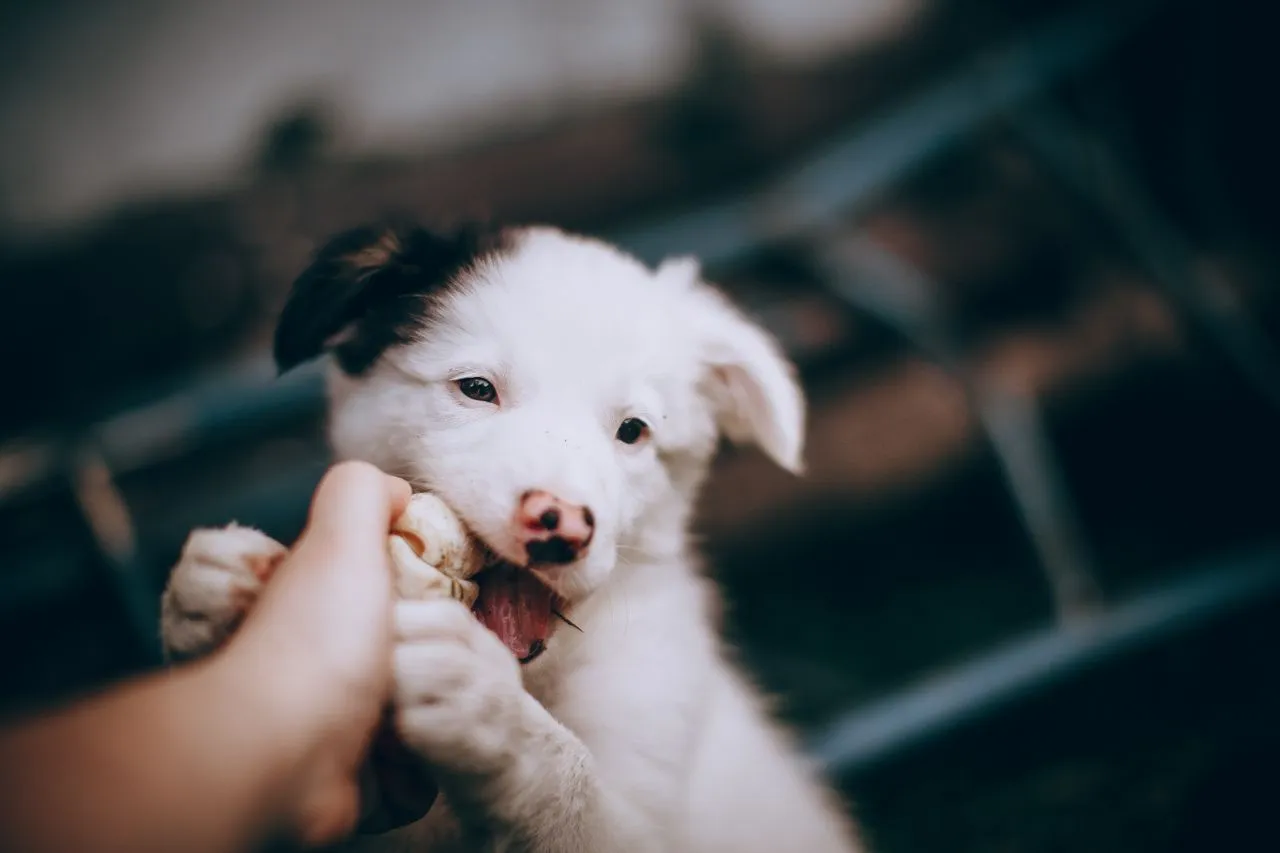
It happens fast. One second you’re crouched down saying hello to your new puppy, and the next, tiny needle-sharp teeth are locked onto your sleeve, your shoelace, or your finger. You yelp, pull back, and the puppy — thrilled by the sudden movement — comes back for round two.
If this sounds familiar, take a breath: you’re not doing anything wrong, and your puppy isn’t “bad.” Mouthing and nipping are part of normal puppy development, the canine equivalent of a toddler grabbing everything within reach to figure out what it is. But normal doesn’t mean you should just wait it out and hope for the best. Left unaddressed, playful nipping can turn into a genuinely painful habit — for you, for visitors, and especially for kids.
This guide walks through why puppies bite, what to expect at each age and stage, and exactly what to do the next time those teeth make contact with your skin. We’ll also cover how to tell ordinary mouthing apart from something that needs professional attention, because that distinction matters more than most first-time owners realize. The goal isn’t a single magic trick that stops biting overnight — it’s a consistent, reward-based approach that actually works with how puppies learn.
Is Puppy Biting Normal?
Why do puppies explore with their mouths?
Dogs don’t have hands, so their mouths do the exploring. A puppy investigating a new texture, testing a moving object, or figuring out what’s edible will almost always use its teeth first. Think of it the way a human toddler grabs, squeezes, and mouths new objects before they’ve developed the fine motor skills — and vocabulary — to explore any other way. For a puppy, that stage just involves more teeth.
This is exactly why fingers, shoelaces, sleeves, and ankles are such magnets for puppy attention. They move. They’re interesting. And unlike a stationary chew toy, they react — which, from a puppy’s point of view, makes the game even more fun.
Play biting versus harmful biting
Most of what new owners describe as “biting” is actually mouthing: soft, exploratory contact that isn’t meant to cause harm. Nipping is a step up — quicker, sharper little bites usually tied to excitement or play. Because puppy teeth are essentially rows of tiny needles, even a fully playful nip can leave a mark or genuinely hurt, which understandably alarms new owners.
It helps to reframe the goal here. You’re not trying to shut down your puppy’s need to communicate or explore — that would be unrealistic and unfair. You’re teaching a still-developing animal how to interact with human skin gently, the same way its littermates would have taught it before you brought it home.
What current research tells owners
Mouthing, nipping, and chewing on hands or clothing consistently show up as one of the most commonly reported behavioral concerns among young dogs, and it’s a near-universal experience for new puppy owners rather than a sign that something is uniquely wrong with your dog. What doesn’t exist is a single trustworthy statistic stating what percentage of puppies bite their owners — most available data either lumps puppies in with adult dogs or measures reportable bite injuries, not everyday mouthing. If you see a headline citing a specific percentage of puppies who bite, treat it with healthy skepticism. It’s simply not a number the research currently supports.
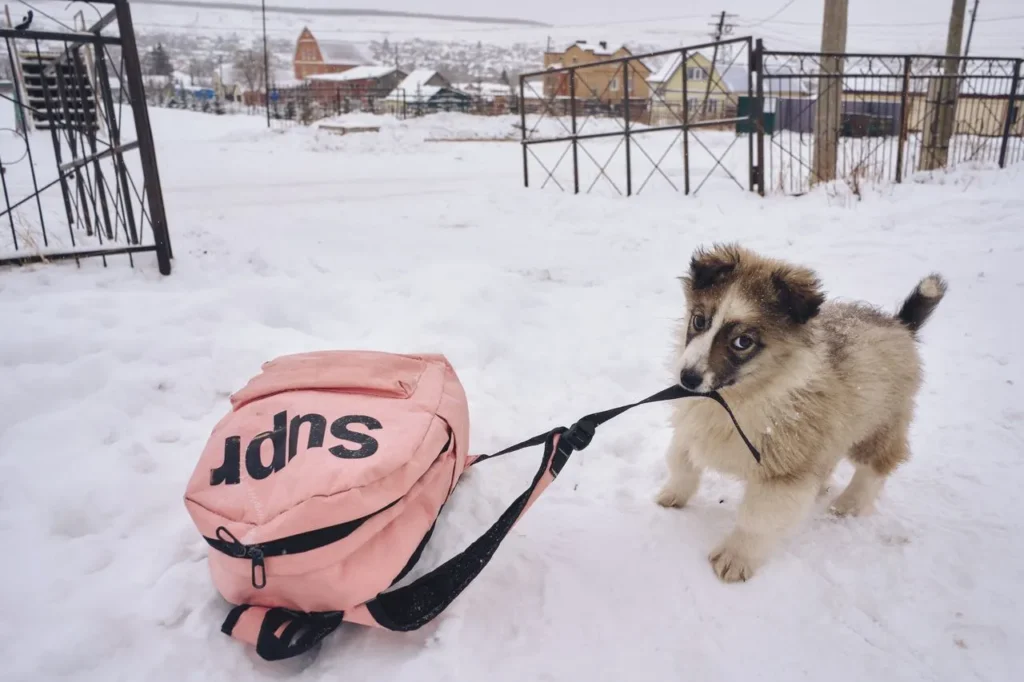
Why Does My Puppy Bite Me?
Biting rarely has just one cause. More often, several factors are stacked on top of each other, which is why understanding the “why” is often the fastest route to fixing the “what.”
Normal play and social interaction
Chasing, wrestling, and excited greetings are prime biting triggers. And here’s the part owners often miss: our own reactions can accidentally turn biting into a game worth repeating. When a puppy nips and you yank your hand away with a startled squeal, you’ve just created movement and drama — both of which are, from a puppy’s perspective, extremely rewarding. The chase is on.
Teething discomfort
Puppies are born with 28 baby teeth, and by adulthood they’ll have as many as 42 permanent ones. That transition typically begins around 12 weeks and wraps up by roughly six months of age, though the timeline varies from dog to dog. During this stretch, sore gums make chewing genuinely comforting — puppies aren’t being difficult; they’re seeking relief the same way a teething infant reaches for a cold washcloth.
Overtiredness and overstimulation
If you’ve noticed your puppy turns into a biting whirlwind right around dinnertime or after a long play session, you’ve spotted a real and well-documented pattern. Overtired puppies lose behavioral control the way overtired toddlers melt down — not because they’re misbehaving on purpose, but because they’ve run out of the self-regulation needed to settle themselves. More play usually makes this worse, not better. What actually helps is rest.
Attention-seeking and accidental reinforcement
Talking to your puppy, pushing it away, or chasing it off can all function as attention — and attention is a reward, even when it’s delivered as a scolding. This gets complicated in multi-person households, where one family member might firmly ignore nipping while another laughs and roughhouses right back. Puppies pick up on these inconsistencies quickly, and mixed signals slow down learning considerably.
Hunger, frustration, boredom, or unmet needs
Sometimes biting is simply a puppy telling you it needs more from its day: more mental stimulation, more appropriate things to chew, a steadier routine. It’s tempting to assume the fix is “more exercise,” but puppies need a balance of physical activity, mental engagement, and genuine downtime. A puppy that’s only ever physically tired — without enough enrichment or rest — often ends up more wound up, not less.
Puppy Biting by Age: What to Expect
Biting behavior shifts as puppies grow, and knowing what’s typical for each stage can save you from unnecessary worry — or from mistaking a normal phase for a training failure.
Eight to twelve weeks
This is peak exploration and social-play territory, and your puppy has essentially no impulse control yet. Don’t expect restraint. Focus your energy on prevention (keeping tempting objects out of reach), gentle redirection, and building a predictable routine your puppy can settle into.
Three to four months
Teething becomes more noticeable, and biting often ticks upward when your puppy is excited or physically uncomfortable. This is a good window to introduce short, low-pressure training sessions — nothing intense, just consistent.
Five to six months
Most of the permanent teeth have come in or are close to coming in. If you’ve been consistent with training, this is often when owners start to notice real improvement in self-control. If biting is still intense and escalating rather than easing off, it’s worth looking at the fuller context rather than assuming it will simply resolve on its own.
Seven to ten months
Welcome to adolescence — a phase that can bring a fresh burst of excitement-driven biting, and sometimes a secondary chewing phase as adult teeth settle fully into the jaw. If biting seems to resurface here, it doesn’t mean earlier training failed. It means management is still part of the job.
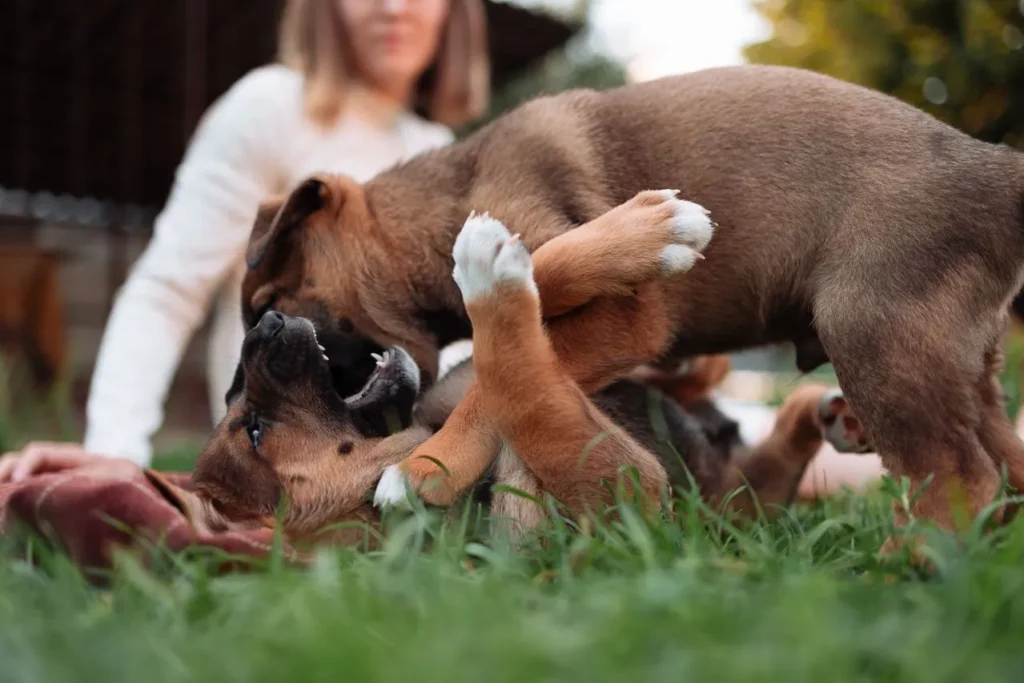
Puppy-Biting Stages and Recommended Responses
| Puppy Age | Likely Reason for Biting | Typical Pattern | Best Owner Response |
| 8–12 weeks | Exploration and social play | Hands, sleeves, moving feet | Redirect and briefly pause play |
| 3–4 months | Early teething and excitement | More frequent chewing and nipping | Offer safe chew toys and schedule rest |
| 5–6 months | Peak tooth replacement | Pressure-seeking and object chewing | Reinforce calm behavior and supervise |
| 7–8 months | 7–8 months | Jumping, grabbing clothes, rough play | Use structured games and impulse-control training |
| 8–10 months | Secondary chewing phase | Renewed interest in chewing objects | Continue puppy-proofing and toy rotation |
Play Biting, Teething, Fear, or Aggression?
Not all biting comes from the same place, and learning to read the difference is one of the most useful skills you can develop as a puppy owner.
Signs of playful puppy biting
- A loose, bouncy body rather than a stiff one
- Play bows and generally relaxed movement
- Easy switching between a toy and a person
- Biting that ramps up mainly during excitement
- The ability to disengage and calm back down
Signs of teething-related chewing
- Persistent gnawing on objects rather than people
- Seeking out different textures to chew
- More frequent chewing during the tooth-replacement window
- Mild sensitivity around the gums
- A preference for toys offering gentle, steady pressure
Warning signs that deserve attention
- A stiff or frozen body posture
- Guarding food, toys, resting spots, or “stolen” objects
- Biting triggered by touch in one specific area
- Repeated growling tied to fear or handling
- Bites that are difficult to interrupt
- A sudden shift in behavior
- Biting that intensifies over time instead of gradually easing
Why pain must be ruled out
Discomfort — from ears, teeth, joints, skin, or digestion — can change a puppy’s behavior in ways that look a lot like a training problem but aren’t. If biting increases suddenly and without an obvious behavioral trigger, a veterinary check is worth doing before assuming it’s purely a training issue. And whatever you do, don’t punish growling. Growling is information, not defiance — it’s your puppy telling you it’s uncomfortable, and suppressing that warning signal doesn’t make the underlying feeling go away.
How to Stop Puppy Biting, Step by Step
This is the part most owners are looking for, so let’s get specific. None of these steps work as a one-time fix — they work because you repeat them, calmly, every single time.
Step 1: Become still and calm
The instant teeth touch skin, stop moving the targeted hand, foot, or piece of clothing. Resist the urge to yank away, shout, or spin the moment into a chase. Puppies key in on movement and energy, so a calm, predictable response gives them far less to react to.
Step 2: Redirect to an appropriate toy
Keep a toy within arm’s reach anywhere biting tends to happen — by the couch, near the door, in the hallway. If you can spot the excitement building, offer the toy before things escalate rather than after. When your puppy takes the toy instead of your hand, praise it and keep the play going.
Step 3: End play briefly when biting continues
If redirection doesn’t work, calmly withdraw your attention for a short period. Step behind a gate, or simply disengage and go quiet. The timing matters here — the pause needs to happen close enough to the bite for your puppy to connect the dots. Once things settle, resume the interaction as if nothing happened.
Step 4: Reinforce the behavior you want
Notice and reward the good stuff: a calm approach instead of a jumping one, sitting instead of grabbing at your sleeve, four paws staying on the floor. Praise your puppy when it chooses to carry or chew an appropriate toy instead of your hand. This is the part that’s easy to forget in the moment, but it’s doing just as much work as the corrections.
Step 5: Teach useful replacement cues
A puppy that knows what to do instead of biting will bite less. Build up a small toolkit of cues:
- “Sit”
- “Touch”
- “Drop it”
- “Leave it”
- “Find your toy”
- “Go to your mat”
Step 6: Use controlled games
Tug is a great outlet for biting energy — as long as it has rules. Stop the game the moment teeth touch skin, use a long toy to keep some distance from your hands, and teach your puppy to release and restart the game calmly on request.
Step 7: End sessions before your puppy loses control
Watch for the tells: faster movement, harder biting, barking, zoomies, or a puppy that stops responding to cues altogether. When you see those signs, that’s your cue to wind things down — a potty break followed by quiet rest, rather than another round of play.
Seven Immediate Actions When Puppy Teeth Touch Skin
- Freeze the targeted hand or foot
- Remain calm and avoid yelling
- Offer an appropriate toy
- Praise the puppy for biting the toy
- End play briefly if biting continues
- Check whether the puppy needs a potty break
- Provide quiet rest if the puppy appears overtired
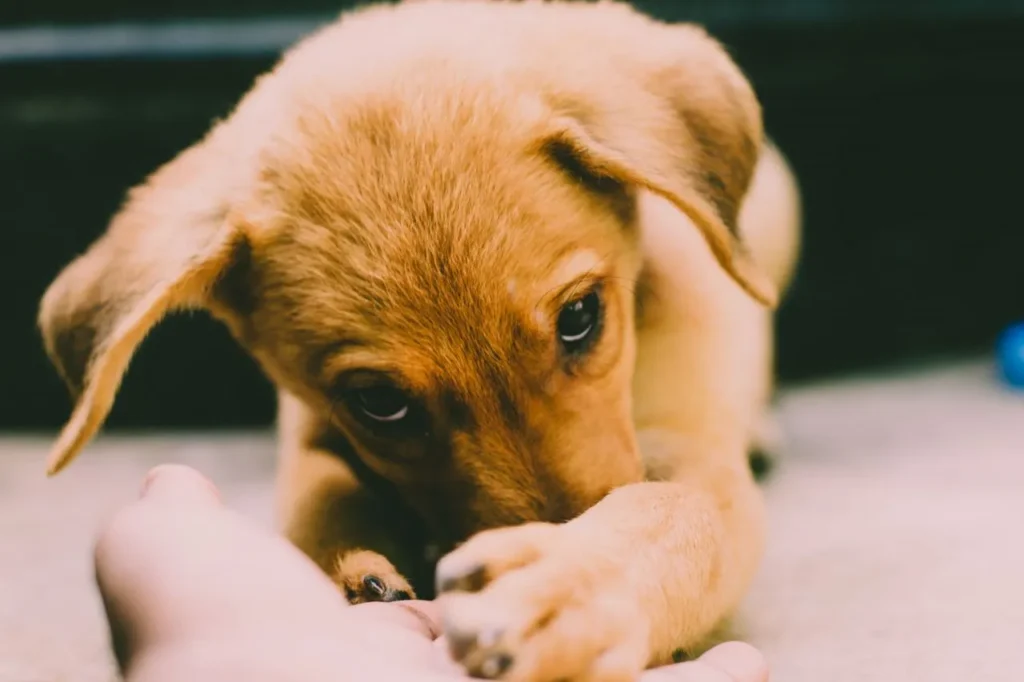
Teaching Bite Inhibition
What bite inhibition means
Bite inhibition is a puppy’s learned ability to control how much pressure it uses with its mouth. It typically starts developing during play with the puppy’s mother and littermates — a yelp from a sibling that got bitten too hard teaches a fast, effective lesson about pressure. Once a puppy leaves that environment, it’s up to us to continue that education. The long-term goal isn’t a puppy that never mouths anything; it’s a dog with a genuinely soft mouth, even in moments of excitement.
Why removing attention can work
Play and human attention are genuinely valuable to a puppy — arguably some of the most valuable things in its world. When rough biting reliably makes that attention disappear, even briefly, the behavior naturally becomes less appealing. The key is consistency: calm interaction resumes only once your puppy has settled, not the instant it stops biting for two seconds.
Should you yelp when your puppy bites?
It depends on the dog. A sharp little yelp interrupts some puppies effectively, mimicking the feedback they’d get from a littermate. For other puppies, that same sound reads as exciting rather than corrective, and it actually ramps up the biting instead of stopping it. If you notice your puppy getting more amped up after you yelp, switch to a quiet, unemotional withdrawal instead. There’s no universal answer here — pay attention to what your individual puppy responds to.
Managing the Home to Prevent Biting
Create puppy-safe areas
Gates, exercise pens, and puppy-proofed rooms aren’t just about protecting your furniture — they reduce the number of biting opportunities in the first place, which makes training far more effective. Keep shoes, kids’ toys, laundry, and anything dangly out of reach, and make sure your puppy has a genuinely quiet space to rest undisturbed.
Keep toys available where biting happens
Stash toys in the spots where nipping tends to occur — by the sofa, near your desk, in the entryway. Rotating toys keeps them feeling novel and interesting, and matching size and durability to your puppy’s stage keeps things safe.
Build a predictable daily routine
A steady rhythm gives your puppy fewer reasons to act out from boredom or overstimulation. A solid routine typically includes:
- Meals
- Potty breaks
- Short training sessions
- Social interaction
- Chewing opportunities
- Age-appropriate activity
- Rest and sleep
Track triggers
Keep a loose log of when, where, and with whom biting tends to happen. Patterns emerge fast — maybe it’s always right before dinner, or whenever the kids start running around, or after visitors leave. Once you spot the pattern, you can get ahead of it.
Safe Chew Toys for a Biting Puppy
Features of an appropriate chew toy
Look for the right size for your puppy’s mouth, a puppy-appropriate material, no small parts that could break off and be swallowed, a texture that’s satisfying without being excessively hard, and something easy to clean and use under supervision.
Using food-filled and chilled toys
Food-filled toys combine chewing with mental enrichment, which is a genuinely efficient way to tire out a puppy’s brain along with its jaw. Chilled, puppy-safe toys can also offer real comfort during teething. Just follow veterinary or manufacturer guidance on what’s appropriate, and keep an eye on any toy your puppy is working on.
Items that may create risks
No chew toy is completely without risk, so it’s worth knowing what to watch for: anything small enough to swallow, cracked or degraded rubber, extremely hard objects that can fracture teeth, fabric or rope pieces that get chewed off and swallowed, and household items like socks that can cause a dangerous obstruction if ingested.
Common Puppy-Biting Mistakes
Playing with hands
Using your bare hands as toys teaches your puppy that human skin is fair game — and then it’s confusing when you correct the exact same behavior five minutes later during a “real” interaction.
Shouting, hitting, muzzle-grabbing, or alpha rolling
These methods tend to increase fear or defensiveness rather than teach a better alternative, and they run counter to the reward-based approach that veterinary behavior experts currently recommend. Beyond being ineffective, they can damage trust between you and your puppy.
Pushing the puppy away
Physical contact and movement often read as an invitation to keep playing. Some puppies will interpret a push as the start of a wrestling match rather than a signal to stop.
Using the crate as punishment
The crate needs to stay a safe, neutral resting place. There’s a real difference between calmly guiding an overtired puppy into the crate for a nap and angrily shoving it in there after a biting incident — and your puppy can tell the difference too.
Expecting instant results
Improvement tends to be gradual, and it’s normal to see setbacks during teething or adolescence. What moves the needle isn’t a single clever technique — it’s everyone in the household responding in the same calm way, every time.
How to Stop a Puppy From Biting Children
Supervision is essential
Young children and puppies should never be left together without an adult actively watching. Step in before things escalate rather than after, and use gates or pens whenever direct supervision isn’t possible.
Teach children safe behavior
A few simple rules go a long way: don’t run and scream around the puppy, don’t yank toys out of its mouth, don’t disturb it while it’s sleeping or eating, avoid hugging or cornering it, and call an adult over if the puppy starts getting too worked up.
Give the puppy appropriate breaks
Kids are loud and unpredictable in the best way — but that same energy can overstimulate a puppy fast. Build in quiet periods away from the chaos of family life, and make a point of rewarding calm interactions between your child and your puppy when they happen.
When to Contact a Veterinarian, Trainer, or Behaviorist
Contact a veterinarian when
Biting starts suddenly and out of nowhere; your puppy reacts defensively to being touched; eating or chewing seems to cause pain; there are visible dental issues or retained baby teeth, or behavioral changes are showing up alongside illness, fatigue, or appetite loss.
Contact a qualified behavior professional when
Biting is getting more intense rather than less; your puppy is guarding food or objects, fear or stiff body language shows up alongside the biting, family members feel genuinely unsafe, children keep being targeted, or you’ve been consistent with management for several weeks without any improvement.
How to choose appropriate help
Look for a reward-based professional and ask directly about their qualifications and experience specifically with puppies. Steer clear of anyone who leans on intimidation, pain, or dominance-based theories — that approach has fallen out of favor for good reason. If there’s a medical component or a serious behavioral concern, look for a trainer willing to coordinate with your puppy’s veterinarian.
Frequently Asked Questions About Puppy Biting
At what age do puppies stop biting? Most puppies show real improvement as teething wraps up and training takes hold, but there’s no universal deadline — every dog’s timeline looks a little different.
Why does my puppy bite me more than everyone else? It usually comes down to access, excitement level, movement, attention, and how consistently you react. Puppies also tend to test boundaries most with whoever they have the closest bond with.
Why does my puppy bite more in the evening? This is an extremely common pattern, usually tied to accumulated tiredness, a full day of stimulation, and unmet rest needs catching up all at once.
Should I hold my puppy’s mouth closed? No. Forcing the mouth shut tends to increase fear rather than teach the behavior you actually want, and it doesn’t give your puppy any real alternative to learn from.
Are puppy time-outs effective? A brief, calm removal of attention can genuinely help. What doesn’t help is a long or angry isolation — that crosses over from teaching into punishment.
Does teething cause all puppy biting? No. Teething plays a role in chewing, but social play, excitement, frustration, and attention-seeking are just as often behind the biting you’re seeing.
What should I do if my puppy breaks the skin? End the interaction safely, clean the wound properly, and seek medical advice if the injury looks serious or concerning. It’s also worth looking back at what led up to the bite so you can head off a repeat.
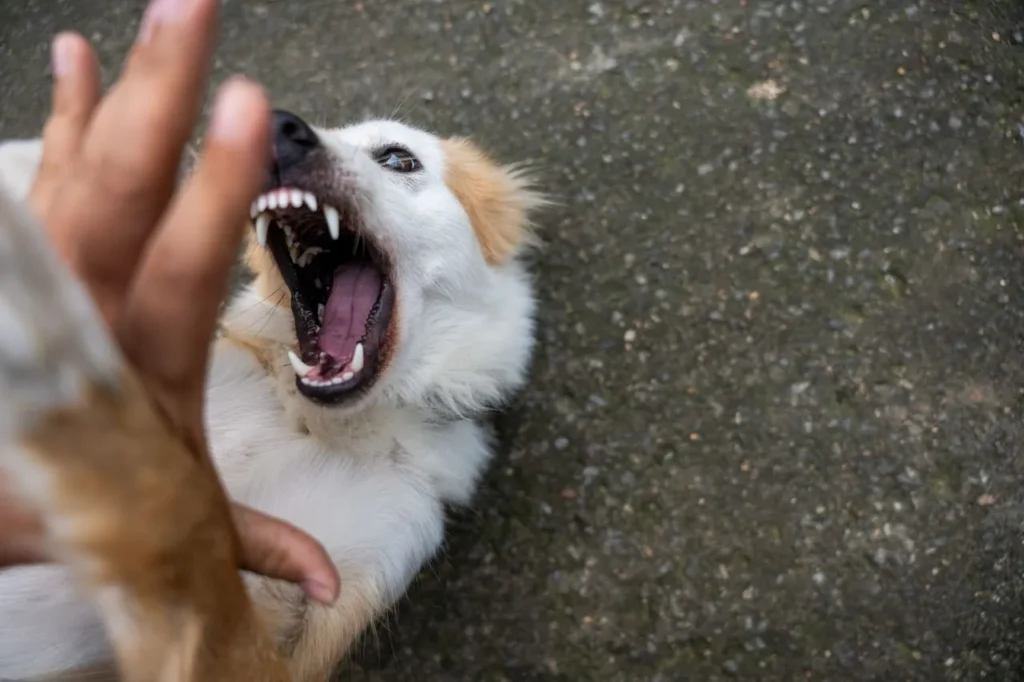
Conclusion
Puppy biting can feel relentless in the moment, but for the vast majority of puppies, it’s a temporary, trainable phase — not a permanent personality trait. The strategy that actually works isn’t complicated: prevent the setup where you can, redirect to something appropriate, pause the fun briefly when teeth touch skin, reward the calm behavior you want to see more of, build in real rest, and stay consistent across everyone in the household. Physical punishment isn’t part of the equation, no matter how frustrated you get in the moment — it tends to create new problems rather than solve the one in front of you.
Progress won’t always be a straight line. You may see real improvement for two weeks and then a rough patch during a growth spurt or a stretch of bad sleep. That’s normal. What isn’t normal is biting that shows up suddenly, escalates instead of easing, or comes paired with fear or pain — those situations deserve a professional set of eyes. For everything else, calm repetition really is the whole strategy. Stick with it, and most puppies grow out of the sharpest edges of this phase well before their first birthday.